From Asking Why to Calculating Answers
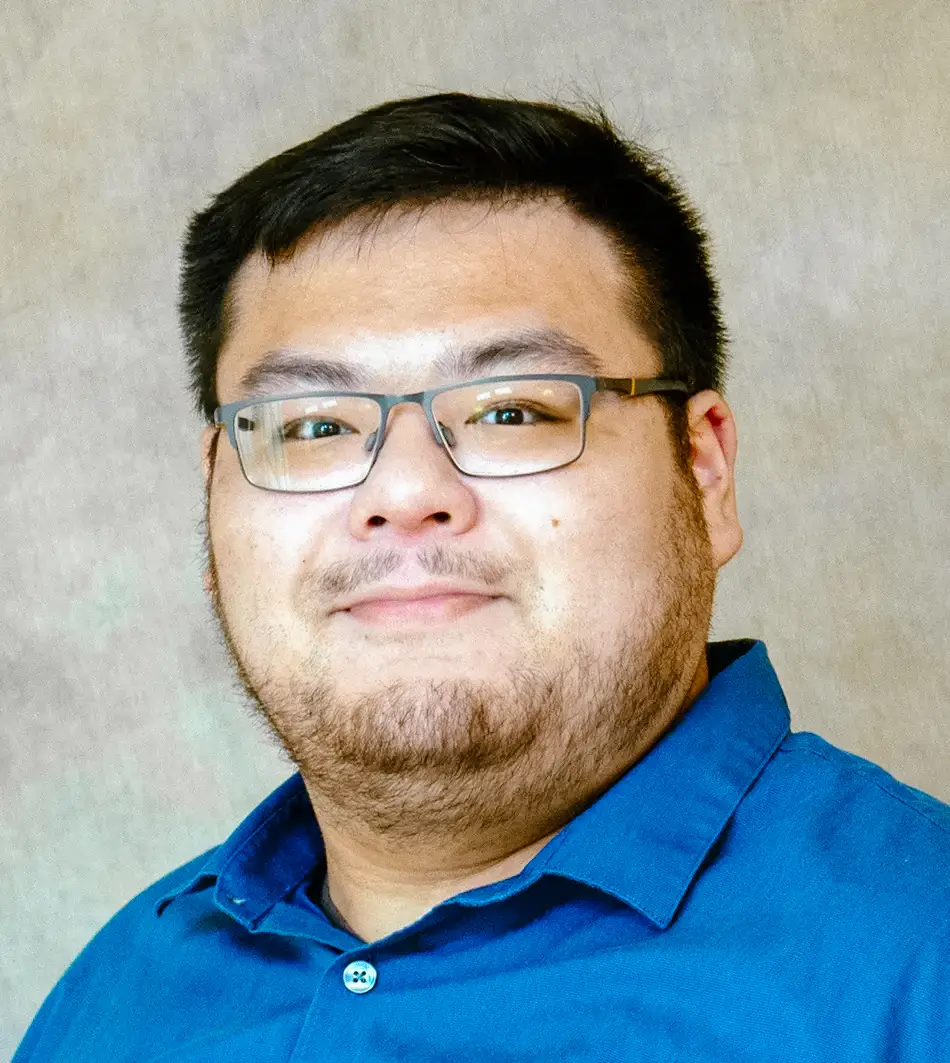
Calvin Wong’s childhood interest in science led him to seek solutions through mathematics. As a doctoral student at UT, he’s been working on research in materials modeling at ORNL.
3 Cs of a Math PhD Student
Calvin Wong’s pursuit of a PhD in applied mathematics at UT is based on what he calls the “3 Cs”:
- Curiosity. “I love hard questions,” Wong said.
- Confidence. Mentors and his success in science, technology, engineering, and math (STEM) competitions proved he could succeed.
- Calling. Wong sees the ability to use math and computation to do something useful for society.

For Ming-Hei (Calvin) Wong, pursuing mathematics in college was about chasing the “why.”
“When I was a kid in Hong Kong, my dad let me watch MythBusters on his computer,” Wong said. “It doubled as English practice and my first real taste of science—science you can see, measure, and argue about. I thought it was awesome, and I became that kid who kept asking ‘Why?’ about everything.”
As an undergraduate student, Wong realized he could use computational mathematics and physics to make models, solvers, and tools. “It changed my early stereotype of academia as something far from everyday life,” he said.
Now a fourth-year doctoral student in applied math at UT, he works on computational partial differential equations (PDEs), multigrid methods, and diffuse-domain techniques. “I’ve done summer research in ORNL (Oak Ridge National Laboratory) on materials modeling, and I enjoy building real codes—MATLAB and Python—to test ideas at scale,” Wong said. “Teaching undergrads also keeps me honest about clarity and impact.”
“UT’s deep collaboration with ORNL gives me day-to-day access to cutting-edge facilities and problems that matter,” he said. “For someone developing computational methods for PDEs and materials modeling, that ecosystem accelerates both my research and my network—faculty, lab scientists, and industry partners. It’s the ideal place to build tools, publish, and form long-term connections.”
Wong’s research includes a mix of projects that are theoretical and that have a direct impact on society.
A core part of his dissertation is related to using the Diffuse-Domain Method (DDM) for solving PDEs. “The DDM lets us solve PDEs with complex and/or moving domains in a pretty pain-free and accurate way, without all the hand-tuned corrections or remeshing you often need in traditional methods like the Finite Element Method (FEM),” Wong said. “We’ve established parts of the theory, and now I’m extending the work from simpler models to fluid-dynamics models.”
He’s also using state-of-the-art scientific machine-learning tools to predict the stable configuration of a metal lattice. “This is a combinatorial optimization problem whose possibilities grow roughly factorially with system size, so brute force isn’t an option,” Wong said. “With reinforcement learning over a graph-neural-network view of the lattice, we’re getting very strong computational efficiency and high-quality solutions on modern CPUs/GPUs.”
Along with UT mathematics Professors Steven M. Wise and Abner Salgado, he is also a co-author on a new graduate-level textbook, Multigrid Methods: Axiomatic Convergence Theory for Linear and Weakly Nonlinear Problems. “Multigrid methods are modern, elegant, and demanding—you have to connect a lot of dots across numerical linear algebra and PDE solvers—but that’s exactly why they’re so satisfying,” Wong said.
“Working with Dr. Wise, a leader in the area, has been an honor,” Wong said. “He put me in charge of writing the runnable code for the book, so I make sure everything works and is written in a way readers can easily follow.”
“Co-authoring a math textbook as a grad student is pretty rare, and I’m grateful he saw the potential in me and brought me onto the team,” Wong said.
Wong met Wise in his first year as a graduate student, and Wise is the advisor for his dissertation. “He sets the bar high and relentlessly helps me to achieve it,” Wong said. “As an international student, he would also invite me to his family’s barbecue party and Thanksgiving party, to help me understand this nation better.”
Professor Cory Hauck, leader of the Multiscale Methods Group at ORNL, has been an important mentor. “He is an experienced scientist in his field, and I learn a lot about how the industry works under his supervision in the lab,” Wong said. Under Hauck’s guidance, he has also learned about the workplace etiquette for scientists in a lab and the importance of effective communication.
Wong appreciates the support he has received at UT through the Math Department Fellowship and the Dawn and Lawrence Taylor Dissertation Awards Endowment/Fellowship.