Making Math Classes Accessible and Engaging
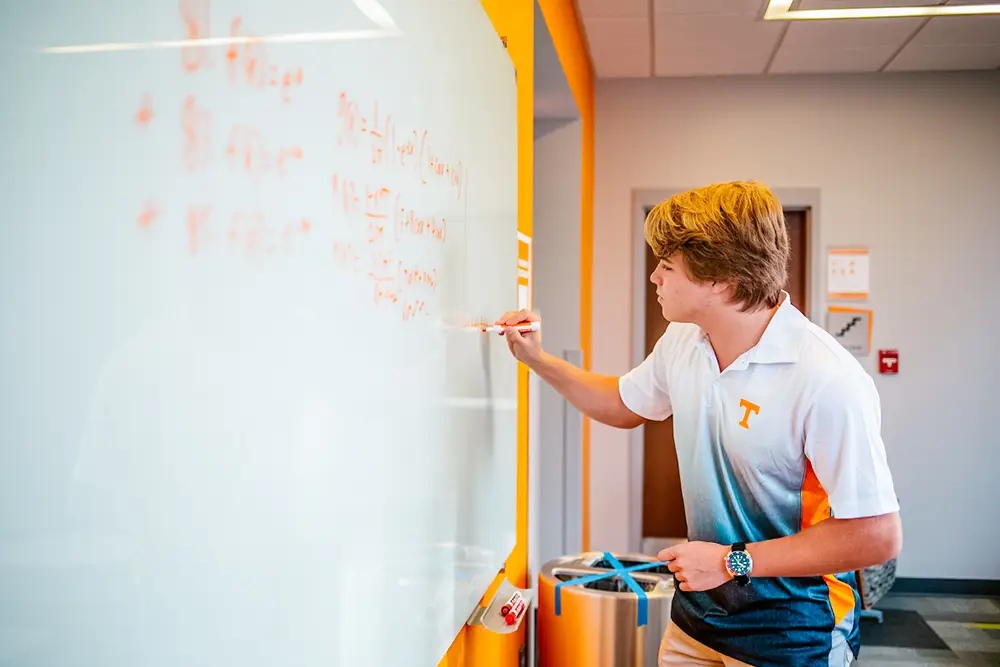
Professor Michael Frazier and Distinguished Lecturer Robert Guest are using their decades of teaching experience to improve analysis and statistical reasoning courses.
Research to Results
Early in his career, Professor Michael Frazier’s research provided one of the predecessors of the theory of wavelets.
A computationally efficient alternative to Fourier Analysis, wavelets allow simultaneous understanding of both the amplitude and the frequency characteristics of a signal.
“Wavelets were applied, for example, in the digitization of the FBI fingerprint files, and in the JPEG digital image compression algorithm that is widely used on the internet,” Frazier said. “It was exciting and profoundly rewarding to contribute to that research effort.
UT Professor Michael Frazier is concerned that students may be discouraged about analysis—or mathematics in general—if their initial experience in a course is negative.
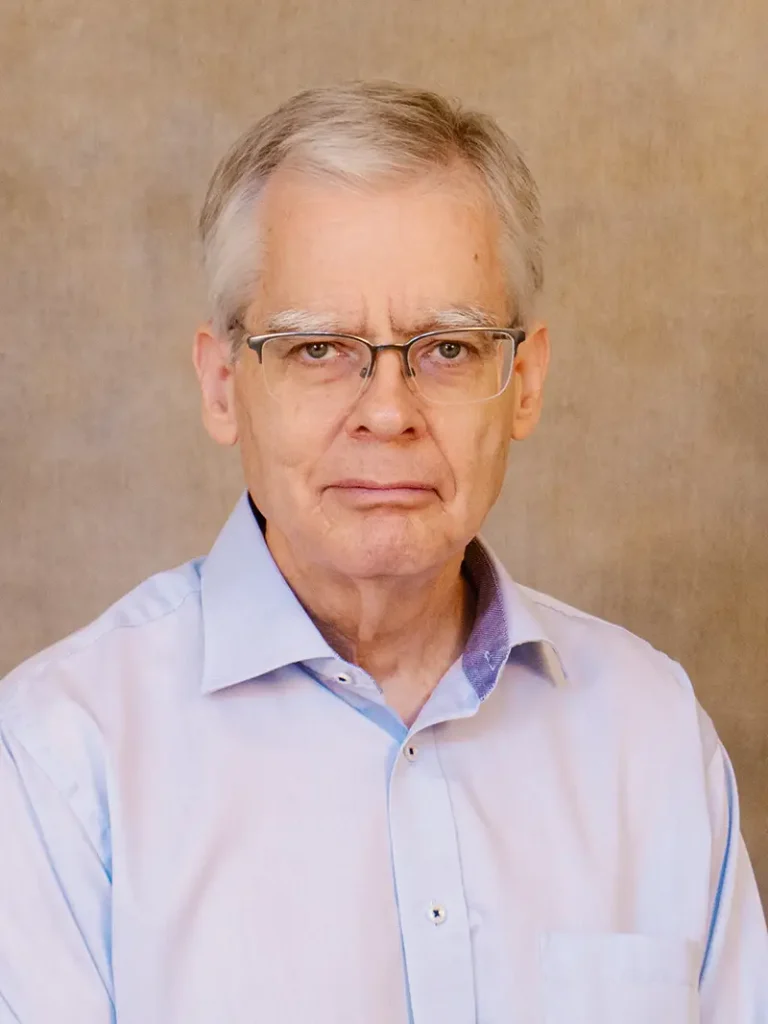
“I did not understand much in my introductory analysis course in 1977, but I thought that with better instruction I might have had the ability to grasp the material,” Frazier said. “I hope that my more than 40-year research career in the field of analysis has validated that belief.”
Frazier joined the UT Department of Mathematics in 2006 and served for six years as department head. He has received numerous teaching awards, and in spring 2025, the College of Arts and Sciences honored him with the James R. and Nell W. Cunningham Outstanding Teaching Award.
“As I approach the end of my career, I am taking on the challenge of improving basic analysis instruction,” Frazier said.
He has been teaching the UT Honors Analysis sequence, Math 447-448, for the past five years. While about half of the students are honors math majors, the others are incoming graduate students. “Nearly all areas of graduate study require a firm foundation in analysis, including differential equations, geometry/topology, numerical analysis, and mathematical biology,” Frazier noted.
“Many of the standard beginning texts in analysis assume too much mathematical sophistication from the start—the text I used as a student certainly did,” he said. “Others are more accessible but not sufficiently thorough.”
Working from lecture notes he updates each year based on students’ feedback, Frazier is creating an introductory analysis text that will enable students to gradually develop their understanding, proof-writing abilities, problem-solving skills, and general mathematical maturity.
“I plan to make this text freely available on an American Mathematical Society website for lecture notes,” he said.
The Math Place Serves Thousands
During his 11 years as director of The Math Place at UT, Distinguished Lecturer Bob Guest oversaw substantial growth.
The support service for students taking not only mathematics courses but also other courses requiring math assistance moved from the basement of Ayers Hall to the second floor of Hodges Library
“Doing so allowed us to grow from a small operation with a maximum capacity of 26 students and a staff of roughly 20 tutors that served around 5,000 student visits a year to what it is now, an operation in the middle of campus that has served over 100 students at the same time right before a major exam,” Guest said.With more than 50 tutors on staff, The Math Place set a record with 17,867 student visits in the 2023-2024 academic year. Learn more about how The Math Place supports students in the College of Arts and Sciences’ article, “Centers Build Writing, Math, and Chemistry Confidence.”
Meanwhile, Distinguished Lecturer Bob Guest is focused on improving the student experience in Statistical Reasoning, Math 115.
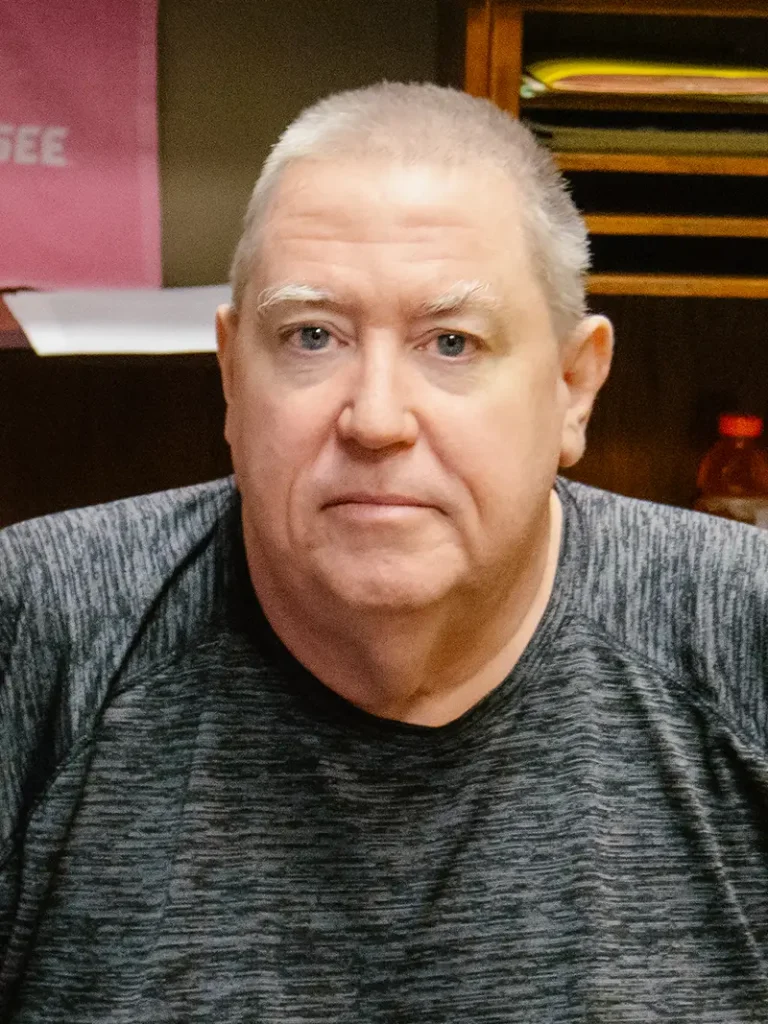
Guest began as a graduate teaching assistant in the department in 1998 and became a full-time lecturer in 2004. In spring 2024, he completed 17 years as the course coordinator for Statistical Reasoning. “I mentored more than 80 graduate students teaching the course,” Guest said. “I created a series of video lectures and class materials for them to use, much of which is still widely used by many instructors.”
“Now I am doing a complete overhaul in my approach to the content to improve the student experience and make class sessions even more hands-on than they have been,” he said. “I am also updating my videos as well as creating new ones, to increase the depth and breadth of what they cover.”
Guest understood early the impact an instructor can have, recalling a high school teacher, Gareth Baumen, fondly. “He not only knew what he was teaching, but he always made the class fun,” Guest said. “He created an environment where it was okay not to be great at math, as long as you were trying to do your best.”
When Guest changed schools, however, he felt the new calculus teacher wrote him off when he asked about a piece of notation he had not seen before. “She assumed that because I did not know it, I must not know what I was doing,” he said.
“These two experiences combined to inspire me to become a math teacher myself,” Guest said. He was drawn to mathematical statistics because he saw a clear path from the most abstract mathematical results to practical real-world applications.