Working at the Intersection of Math and Biology
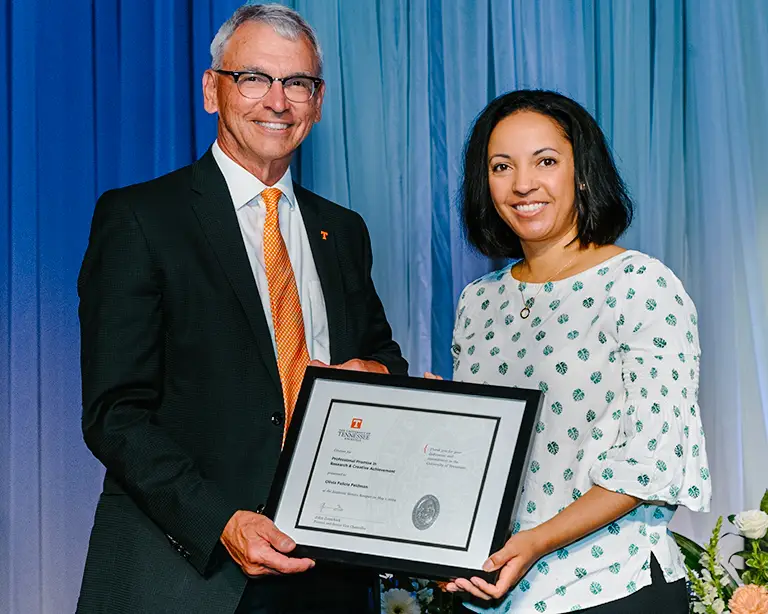
Associate Professor Olivia Feldman develops models that track how infectious diseases spread and introduces undergraduates from multiple majors to the field.
Why I Do What I Do
“During my studies at the University of Florida, I tragically lost two of my aunts to colon cancer in their early 40s. Devastated, I began to wonder whether mathematics—my growing academic passion—could be used to help improve human health. That search led me to the field of mathematical biology.
“Now, being around the same age my aunts were when they passed and raising three young children of my own, I feel even more deeply the importance of using mathematics to advance our understanding of human health.”
Olivia Feldman
Associate Professor
Associate Professor Olivia Feldman is inspired by the power of mathematics to address public health issues. She’s developing infectious disease models and helping to train undergraduate and high school students in mathematics and coding.
“I use mathematical tools to better understand how diseases spread, particularly vector-borne infections such as malaria, a parasitic disease transmitted between humans and mosquitoes through bites,” she explained. “My work involves a range of dynamical systems and computational approaches, including differential equations, integral equations, stochastic processes, and individual-based models (IBMs); in many cases, the biological questions motivate hybrid methods that combine these techniques.”
Recently, she has focused on how immunity builds within a community over time through repeated exposure to infectious mosquito bites.
One collaboration spurred by an American Mathematical Society (AMS) Mathematical Research Community studies how immunity evolves with age under different transmission conditions and external pressures, such as the use of vaccines.
“With more detailed simulation-based approaches like IBMs, Professor Lauren Childs (Virginia Tech) and I examine how immunity, mosquito biology, and parasite genetic diversity interact to influence disease spread, including the emergence and transmission of drug-resistant strains,” Feldman said.
In another AMS collaboration, the group is using integral equations to study the spread of drug-resistant parasites under the selection pressure of antimalaria drugs. “This involves the challenging task of linking within-human parasite dynamics to population-level transmission in a multi-scale malaria modeling framework,” she said.
Feldman is also developing methods to improve how epidemiological data are collected, so that mathematical models can more effectively inform hypotheses and public health strategies.
“Two of my current PhD students are advancing this area by using Monte Carlo and neural network methods to estimate model parameters and uncertainties while relaxing many of the overly simplistic assumptions often made about noise in epidemiological time-series data that can lead to erroneous conclusions about the system,” she said.
Mentoring Undergraduates
With support from a National Science Foundation (NSF) CAREER Award, Feldman founded and has directed the Junior Modelers Program (JuMP) since 2022. An undergraduate training initiative in mathematical epidemiology, JuMP introduces students from a variety of majors to the mathematics and coding behind infectious disease modeling.
Requiring only college algebra, the program involves three 10-week modules covering discrete-time deterministic models, continuous-time deterministic models, and stochastic models.
“With the help of my graduate and advanced undergraduate mentors, it has been incredibly rewarding to watch students progress from no prior modeling or coding experience to independently simulating disease models in Python and communicating their findings across disciplines,” Feldman said.
She has also co-led two workshops for undergraduates and high school students as part of a collaborative NSF project on linking epidemiological and economic models for vector-borne diseases.
“Participants engaged in professional development panels, lectures, and tutorials on malaria modeling, and computer lab sessions in MATLAB and Python,” Feldman said. “The students concluded the workshop by presenting impressive research projects developed in just a few days, demonstrating both technical growth and interdisciplinary collaboration.”