• Request Info
  • Visit
  • Apply
  • Give
  • Request Info
  • Visit
  • Apply
  • Give

Search

A-Z Index Map

Mathematics

  • About
    • Assessment Plan
    • Mission Statement
    • Newsletter
    • Open Jobs
    • SharePoint Site
  • People
    • Administration
    • Faculty
    • Visiting Scholars
    • Graduate Students
    • Staff
    • In Memoriam
  • Undergraduate
    • Major/Minor/Honors
    • Scholarships
    • Careers
    • Math Placement
    • Testing Support Center
    • The Math Place
  • Graduate
    • Degree Programs
    • Funding & Assistantships
    • Request Information
    • Application Checklist
    • Apply Now
    • Handbook
    • MGSC
  • Research
    • Faculty in Research Areas
    • Grants
    • Journal
    • Labs
  • Alumni and Friends
    • Connect with Us
    • Recent PhDs
    • Board of Visitors
  • Events and Visitors
    • Calendar
    • SIAM SEAS 2025
    • Barrett Memorial Lectures
    • Honors Day 2026
Home

Archives

Manderscheid Appointed to National Academies Committee

May 6, 2026 by Kaitlin Coyle

The orange Power T Flag flies high against a cloudy blue sky.

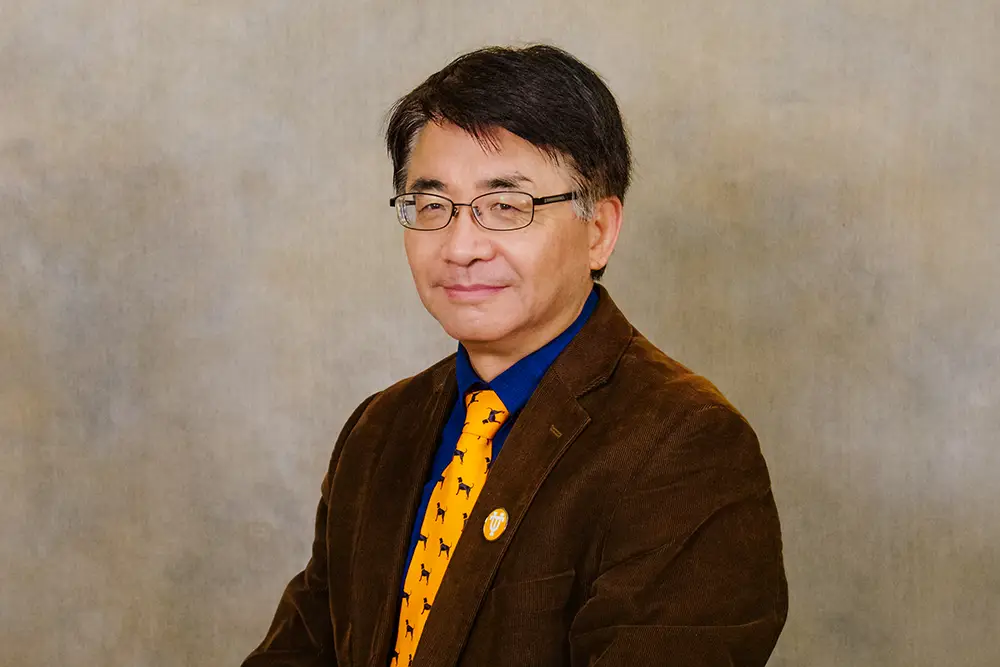
Professor of Mathematics David Manderscheid has been chosen to be a part of an ad-hoc committee on modernizing mathematical sciences education for the National Academies of Sciences, Engineering, and Medicine.

David Manderscheid, professor of mathematics and previous Provost and Senior Vice Chancellor at the University of Tennessee, Knoxville, has been appointed to a National Academies of Sciences, Engineering, and Medicine (NASEM) ad-hoc committee. NASEM is the collective scientific national academy of the United States created to provide independent advice and research to the government on science and technology issues. The Committee on Modernizing Mathematics Education in Grades 9–14 has been created to conduct a consensus study on mathematical sciences education. 

“Math education is at a critical juncture. We must prepare students for a world that runs on data and AI,” said Manderscheid. “How do we change curriculum to do that? What do we add, and perhaps most importantly, what do we jettison?” 

According to the NASEM website, the committee’s report will “address how US mathematics 

education for Grades 9–14 could be modernized to reflect the evolving role of the mathematical sciences and to provide all students with the mathematical tools to pursue their future goals.”

As the roles of mathematical science and research in today’s world grow, the institution believes that a student’s mathematical education in the grades 9–14 range can either advance or hinder a student’s experiences in their daily life, education, or career. The committee’s role is to find out what knowledge and practices would help all students be prepared to achieve future goals and if modernized mathematics education could overlap with a variety of pathways; what type of teaching approaches and experiences have shown to be effective; and what roles technology can have to empower learning.

At the end of the study, the committee will provide recommendations to K–12 and post-secondary education decision-makers on how they can use their curriculum, pedagogy, and standards to help advance students’ education in mathematics. 

“NASEM is the premier science organization in the country and thus it is an honor for me and UT to be selected to this committee that will have a substantial national impact,” said Manderscheid. “I am very interested in how we coordinate curriculum between high school and college so all students can thrive.”

by Sloan Docekal
Filed Under: Featured

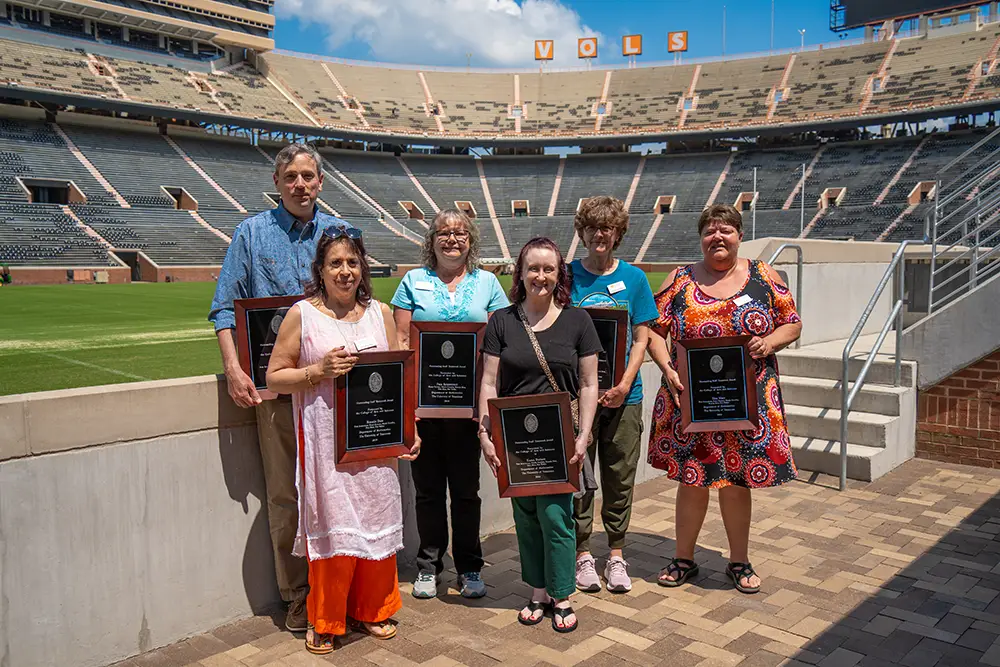
Staff from the Department of Mathematics hold awards while standing in Neyland Stadium.

Math Staff Honored for MAA-SE Meeting

February 6, 2026 by Kaitlin Coyle

Staff from the Department of Mathematics hold awards while standing in Neyland Stadium.

Six staff members from the Department of Mathematics received Outstanding Staff Teamwork Awards from the College of Arts and Sciences.

Department of Mathematics staff members Pam Armentrout, Karen Burnett, Nicole Crombie, Rosario Dow, Tina Murr, and Ben Walker were recognized by the UT College of Arts and Sciences for outstanding work during a staff appreciation event in June 2025. 

Math Department Head Xiaobing Feng nominated them for their contributions when the department hosted the Annual Meeting of the Southeastern Section of the Mathematical Association of America in March 2024. 

They worked closely with faculty members to assist with registration, lodging, space, refreshments, the program, and technology support, helping ensure a successful meeting for more than 600 attendees, showing visitors the true meaning of the Volunteer Spirit.


Filed Under: Newsletter

Jennifer Minutolo.

Minutolo Takes Students from Struggle to Success

February 6, 2026 by Kaitlin Coyle

Jennifer Minutolo.

Teaching Assistant Professor Jennifer Minutolo helps students achieve success through engagement and collaboration.

“My passion is to engage students who typically have difficulties with mathematics,” said Teaching Assistant Professor Jennifer Minutolo. “My goal is to make the subject more attainable for them through cultivating an atmosphere in the classroom of collaboration and learning.”

She also works as advisor to the department’s graduate teaching assistants, passing on not only classroom methods but also her love of teaching. 

“My focus on student engagement has built over time, as I have encountered students who struggle with understanding concepts and making connections,” she said. “I view teaching as my opportunity to speak hope into the lives of my students by giving them a glimpse of success at something that they have always struggled with.”


Filed Under: Newsletter

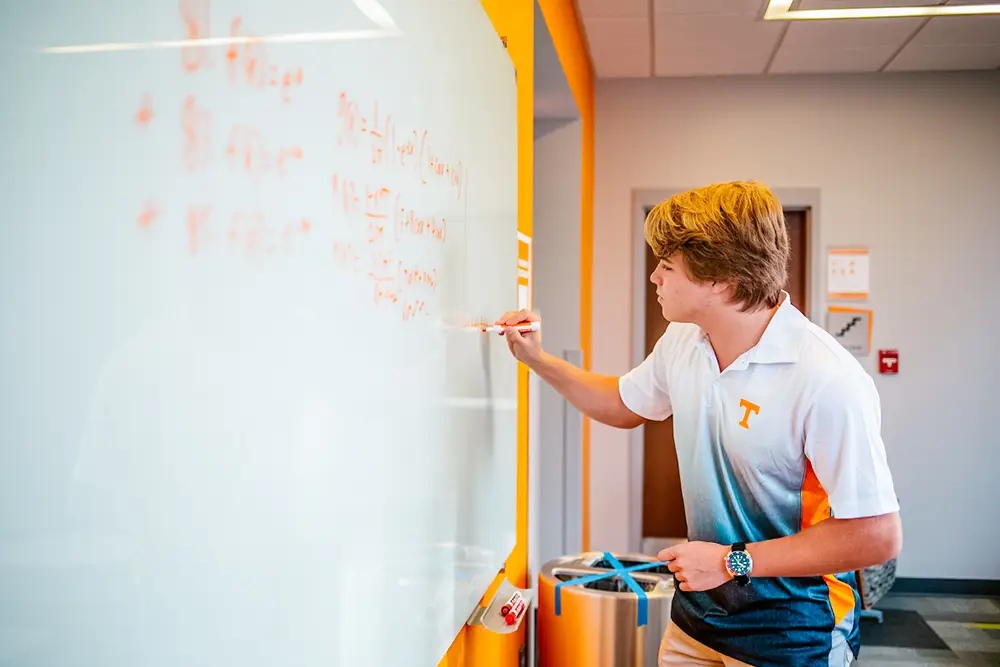
A student writes math equations on a dry erase board.

Making Math Classes Accessible and Engaging

February 5, 2026 by Kaitlin Coyle

A student writes math equations on a dry erase board.

Professor Michael Frazier and Distinguished Lecturer Robert Guest are using their decades of teaching experience to improve analysis and statistical reasoning courses.

Research to Results

Early in his career, Professor Michael Frazier’s research provided one of the predecessors of the theory of wavelets. 

A computationally efficient alternative to Fourier Analysis, wavelets allow simultaneous understanding of both the amplitude and the frequency characteristics of a signal.  

“Wavelets were applied, for example, in the digitization of the FBI fingerprint files, and in the JPEG digital image compression algorithm that is widely used on the internet,” Frazier said. “It was exciting and profoundly rewarding to contribute to that research effort.

UT Professor Michael Frazier is concerned that students may be discouraged about analysis—or mathematics in general—if their initial experience in a course is negative.

Mike Frazier.
Professor Michael Frazier

“I did not understand much in my introductory analysis course in 1977, but I thought that with better instruction I might have had the ability to grasp the material,” Frazier said. “I hope that my more than 40-year research career in the field of analysis has validated that belief.”

Frazier joined the UT Department of Mathematics in 2006 and served for six years as department head. He has received numerous teaching awards, and in spring 2025, the College of Arts and Sciences honored him with the James R. and Nell W. Cunningham Outstanding Teaching Award. 

“As I approach the end of my career, I am taking on the challenge of improving basic analysis instruction,” Frazier said. 

He has been teaching the UT Honors Analysis sequence, Math 447-448, for the past five years. While about half of the students are honors math majors, the others are incoming graduate students. “Nearly all areas of graduate study require a firm foundation in analysis, including differential equations, geometry/topology, numerical analysis, and mathematical biology,” Frazier noted.

“Many of the standard beginning texts in analysis assume too much mathematical sophistication from the start—the text I used as a student certainly did,” he said. “Others are more accessible but not sufficiently thorough.”

Working from lecture notes he updates each year based on students’ feedback, Frazier is creating an introductory analysis text that will enable students to gradually develop their understanding, proof-writing abilities, problem-solving skills, and general mathematical maturity. 

“I plan to make this text freely available on an American Mathematical Society website for lecture notes,” he said.

The Math Place Serves Thousands

During his 11 years as director of The Math Place at UT, Distinguished Lecturer Bob Guest oversaw substantial growth.

The support service for students taking not only mathematics courses but also other courses requiring math assistance moved from the basement of Ayers Hall to the second floor of Hodges Library

“Doing so allowed us to grow from a small operation with a maximum capacity of 26 students and a staff of roughly 20 tutors that served around 5,000 student visits a year to what it is now, an operation in the middle of campus that has served over 100 students at the same time right before a major exam,” Guest said.With more than 50 tutors on staff, The Math Place set a record with 17,867 student visits in the 2023-2024 academic year. Learn more about how The Math Place supports students in the College of Arts and Sciences’ article, “Centers Build Writing, Math, and Chemistry Confidence.”

Meanwhile, Distinguished Lecturer Bob Guest is focused on improving the student experience in Statistical Reasoning, Math 115.

Bob Guest.
Distinguished Lecturer Robert Guest

Guest began as a graduate teaching assistant in the department in 1998 and became a full-time lecturer in 2004. In spring 2024, he completed 17 years as the course coordinator for Statistical Reasoning. “I mentored more than 80 graduate students teaching the course,” Guest said. “I created a series of video lectures and class materials for them to use, much of which is still widely used by many instructors.”

“Now I am doing a complete overhaul in my approach to the content to improve the student experience and make class sessions even more hands-on than they have been,” he said. “I am also updating my videos as well as creating new ones, to increase the depth and breadth of what they cover.”

Guest understood early the impact an instructor can have, recalling a high school teacher, Gareth Baumen, fondly. “He not only knew what he was teaching, but he always made the class fun,” Guest said. “He created an environment where it was okay not to be great at math, as long as you were trying to do your best.”

When Guest changed schools, however, he felt the new calculus teacher wrote him off when he asked about a piece of notation he had not seen before. “She assumed that because I did not know it, I must not know what I was doing,” he said. 

“These two experiences combined to inspire me to become a math teacher myself,” Guest said. He was drawn to mathematical statistics because he saw a clear path from the most abstract mathematical results to practical real-world applications.

Filed Under: Newsletter

Renee Fister.

Problem-solving Drives Fister’s Career

February 5, 2026 by Kaitlin Coyle

Renee Fister.

An undergraduate research opportunity first brought K. Renee Fister to UT, where she found support and inspiration.

K. Renee Fister (MS ’92, PhD ’96), an associate provost and professor of mathematics at Murray State University, has: 

  • Published 36 research papers on mathematical biology/optimal control, many of which involved students
  • Delivered more than 100 research presentations
  • Written 30 successful research grants, serving as principal investigator on 21 grants
  • Mentored 30 students in interdisciplinary research areas for undergraduate and master’s degree projects

“In my work, I developed predictive models for enrollment and work on academic program review with quantitative and qualitative methodology,” said Fister. 

Her love of problem-solving started in junior high. “I wanted to solve problems that could find a cure for cancer and thought I would be a medical doctor to do that,” she said. A research experience for undergraduates first brought her to UT, working with mathematics Professor Phil Schaefer. “I enjoyed the twists and turns that the work provided mentally and the challenges to be achieved,” she said. 

The ability to work with faculty on applied mathematics problems, including Chancellor’s Professor Suzanne Lenhart, brought her back to UT for graduate school. “She supported me both in my mathematics work and my personal growth,” Fister said.

“She has helped scores of people to find their calling in mathematics and life,” Fister said. “She is an amazing mathematician, but more importantly, she pushes you to be better than you ever imagined while supporting you on each step of the journey. “


Filed Under: Newsletter

Amber Young.

Research, Collaboration, and Opportunity

February 5, 2026 by Kaitlin Coyle

Amber Young.

Amber Young chose the UT Department of Mathematics for her doctoral program because of its strong interdisciplinary approach and collaborative environment.

“My research focuses on developing and analyzing mathematical models of infectious disease transmission. 

“One of my dissertation projects involves creating and analyzing the first model of La Crosse virus transmission from mosquitoes to humans. Another project uses stochastic simulations and patient hospitalization records to explore how patient movement patterns influence the spread of infections within healthcare settings. 

“My advisor, [Chancellor’s Professor] Suzanne Lenhart, has been instrumental in helping me gain confidence in my research. She has encouraged me to engage in meaningful interdisciplinary collaborations that have broadened my perspective and strengthened the impact of my work. Through her guidance, I have had opportunities to participate in the Masamu Advanced Study Institute workshop and present at the Southern Africa Mathematical Sciences Association (SAMSA).

“Presenting my work at conferences has also expanded my professional network and allowed me to engage with new research perspectives that continue to shape my career goals. 

“Involvement in the Multicultural Graduate Student Organization (MGSO) has helped me strengthen my leadership and communication skills while fostering connections with students from diverse academic backgrounds.”

Amber Young

PhD Student

Mathematical biology


Filed Under: Newsletter

Nicolette Abate stands in front of Ayres Hall on the University of Tennessee's campus.

Abate Finds Community and Creativity in Math

February 5, 2026 by Kaitlin Coyle

Nicolette Abate discovered community in the UT math department during a Tennessee Governor’s School and graduated this spring with undergraduate research experience.

Math has always been important to Nicolette Abate, and in UT’s Department of Mathematics, she found encouragement and opportunities to take her interest to new levels.

“When I was about 8, I stopped my mom from buying too much Thanksgiving turkey by converting the pounds to ounces and calculating how much we needed,” Abate said. “From there, math became part of how I understood the world.”

Nicolette Abate stands in front of Ayres Hall on the University of Tennessee's campus.
Nicolette Abate

The summer before her senior year of high school, she attended a Tennessee Governor’s School at UT and took a math course with Professor Remus Nicoara.

“I found myself surrounded by people who loved math just as much as I did, and I left feeling deeply inspired,” she said. “During that program, I also learned about the sense of community within the UT math department. I knew I wanted to be part of that same collaborative and welcoming environment.”

Abate is a member of the Mathematics Honors Program in the Class of 2026, with a second major in Hispanic studies and a minor in leadership.

“Dr. Joan Lind has been an ongoing source of encouragement and guidance, helping me choose courses, being my teacher, and overall supporting and encouraging me,” Abate said. 

“My undergraduate research under Dr. Remus Nicoara has also been influential, as it has encouraged me to look into the more creative aspects of math using both coding and theoretical approaches,” she said. 

Courses such as the honors abstract algebra and analysis sequences with Associate Professor Marie Jameson and Professor Michael Frazier strengthened her proof-writing abilities and prepared her for graduate-level courses. 

“I am grateful for the various math scholarships I have received, as well as study abroad scholarships, that allowed me to put all of my efforts into my coursework, research, and student organizations,” Abate said. 

As an undergraduate, her activities outside the classroom included being involved in the Student Government Association and serving as a peer mentor for Spanish courses, developing communication and other skills she will carry into her future roles in education and research.


Filed Under: Newsletter

Peltier’s Research Earns Goldwater Scholarship

February 5, 2026 by Kaitlin Coyle

Jack Peltier.

A double major in mathematics and physics, Jack Peltier is focused on quasilinear elliptic PDEs.

Senior Jack Peltier is one of three UT students to receive a Goldwater Scholarship for the 2025-2026 academic year. 

One of the most prestigious undergraduate scholarships of its kind, the program chooses students who show exceptional promise and are planning research-focused careers in mathematics, engineering, and the natural sciences

Peltier is pursuing a double major in mathematics and physics and is working with Professor Tuoc Phan on research in quasilinear elliptic partial differential equations (PDEs). 

As a sophomore, Peltier took both Phan’s PDE course and a Complex Variables course taught by Professor Tadele Mengesha. “Toward the end of Complex Variables, I got to see some especially beautiful applications of the PDEs I had been learning about in a different field,” he said. He saw how interesting and complex the field is, along with how closely it was tied to his physics major. Professor Remus Nicoara encouraged Peltier to contact Phan about possible research projects. 

Peltier presented his work at UT’s Discovery Day and at the Joint Mathematics Meetings in Washington, DC, in January 2026.


Filed Under: Newsletter

Xiaobing-Feng.

Message from the Department Head

February 5, 2026 by Kaitlin Coyle

Xiaobing-Feng.

See how the University of Tennessee is shaping the future of mathematics, investing in strategic hiring, and building interdisciplinary collaboration.

Dear Friends of the UT Department of Mathematics,

As we reflect on the academic year behind us and look ahead to the future, 2024-2025 was another banner year for the math department at the University of Tennessee, Knoxville. 

We continued to have phenomenal growth along with the university’s rise. We added three tenure-line faculty, with one full professor, one associate professor, and one assistant professor, plus 10 new full-time teaching assistant professors. 

The added teaching power allowed our department, for the first time in many years, to cover our service course teaching responsibilities without pressing the panic button. We are grateful to the college’s unwavering support. 

Moreover, the department welcomed another large class of 32 new graduate students to our program. This brings the total number of graduate teaching assistants (GTAs) to 107, plus about 15 graduate research assistants (GRAs). The total number of graduate students in our program is over 120. Furthermore, math majors have also steadily increased, with close to 200 total math majors, including more than 30 in our honors program.

Finally, 2024-2025 was the inaugural year for our department’s actuarial science program. In one year, the enrollment in the program has reached 20, showing a healthy demand and interest in the program. 

Our department continues to prepare for further growth. We successfully conducted four assistant professor and six lecturer/teaching assistant professor searches during the 2024-2025 academic year, and all joined UT in fall 2025. 

Among four assistant professor positions, one was a regular search in differential geometry, and the other three were through the university-level cluster hire initiative, in Science-Informed Artificial Intelligence (AI), Foundational AI, and Precision Health and Environment. 

These cluster programs are the university’s strategic investments in future growth for cutting-edge and impactful research areas, as well as their applications. 

While continuing to strengthen our research in both theoretical and applied mathematics, our department has been collaborating on interdisciplinary research and projects and exploring new opportunities with other departments within the College of Arts and Sciences (such as the Departments of Physics, Chemistry, and Biology) and units across the university and beyond (e.g., the university’s industrial engineering and mechanical engineering programs, Min H. Kao Department of Electrical Engineering and Computer Science, UT Institute of Agriculture, UT Health Science Center, College of Emerging and Collaborative Studies, UT-Oak Ridge Innovation Institute and its Bredesen Center, and Oak Ridge National Laboratory). The university’s cluster hiring program provides a catalyst for further collaborations. 

The Department of Mathematics continues to serve its unique role for the university and the society at large by wholeheartedly embracing and actively contributing to the realization of UT’s strategic vision. Through outstanding research, interdisciplinary collaboration, and unwavering commitment to transformational education, our goal is to continue to shape the future of mathematics and inspire new generations of scholars. 

In 2023-2024, our department underwent a comprehensive Academic Program Review (APR), which occurs once every ten years. The APR carried out a thorough assessment of the department’s performance and well-being in teaching, research/creative activity, and service. It also provided the department opportunities to plan for future adjustments, improvements, and growth. 

With the college’s strong support, the department has been implementing some of the recommendations outlined in the External APR Committee’s report, including improving the efficiency of making teaching and service assignments, introducing policies for differential teaching load, and developing innovative pedagogies to help UT students succeed in their math classes. 

Looking ahead, although there are many uncertainties and challenges, the department now has the strongest position in the past 10 years, and the future looks bright. The department will continue to rise as the university is on the rise. 

In the rest of this newsletter, you will find achievements and profiles of selected faculty, students, and alumni. I hope you enjoy reading about the many wonderful things that happened in our department over the past year.

With gratitude and best wishes,

Xiaobing Feng

Department of Mathematics

Professor and Head

Filed Under: Newsletter

Calvin Wong

From Asking Why to Calculating Answers

February 5, 2026 by Kaitlin Coyle

Calvin Wong.

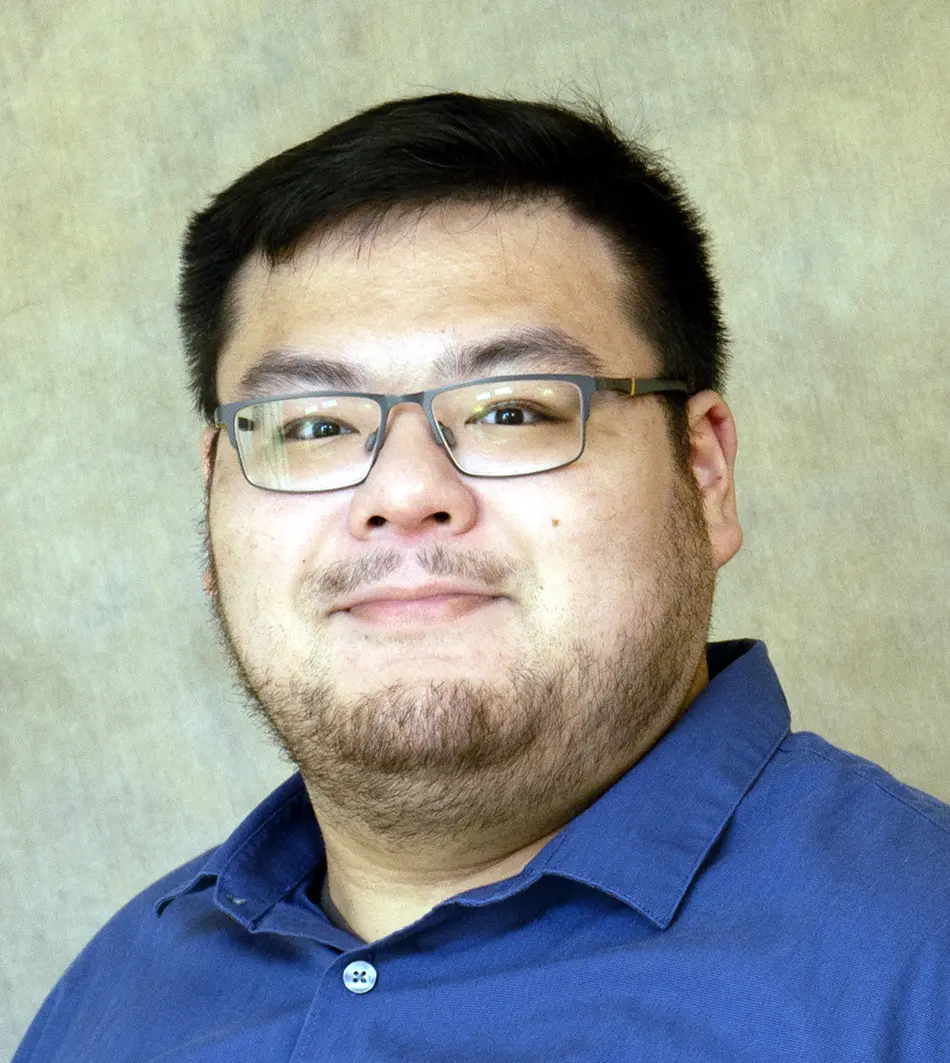
Calvin Wong’s childhood interest in science led him to seek solutions through mathematics. As a doctoral student at UT, he’s been working on research in materials modeling at ORNL.

3 Cs of a Math PhD Student

Calvin Wong’s pursuit of a PhD in applied mathematics at UT is based on what he calls the “3 Cs”: 

  • Curiosity. “I love hard questions,” Wong said. 
  • Confidence. Mentors and his success in science, technology, engineering, and math (STEM) competitions proved he could succeed.
  • Calling. Wong sees the ability to use math and computation to do something useful for society.

For Ming-Hei (Calvin) Wong, pursuing mathematics in college was about chasing the “why.” 

“When I was a kid in Hong Kong, my dad let me watch MythBusters on his computer,” Wong said. “It doubled as English practice and my first real taste of science—science you can see, measure, and argue about. I thought it was awesome, and I became that kid who kept asking ‘Why?’ about everything.”

As an undergraduate student, Wong realized he could use computational mathematics and physics to make models, solvers, and tools. “It changed my early stereotype of academia as something far from everyday life,” he said. 

Now a fourth-year doctoral student in applied math at UT, he works on computational partial differential equations (PDEs), multigrid methods, and diffuse-domain techniques. “I’ve done summer research in ORNL (Oak Ridge National Laboratory) on materials modeling, and I enjoy building real codes—MATLAB and Python—to test ideas at scale,” Wong said. “Teaching undergrads also keeps me honest about clarity and impact.”

“UT’s deep collaboration with ORNL gives me day-to-day access to cutting-edge facilities and problems that matter,” he said. “For someone developing computational methods for PDEs and materials modeling, that ecosystem accelerates both my research and my network—faculty, lab scientists, and industry partners. It’s the ideal place to build tools, publish, and form long-term connections.”

Wong’s research includes a mix of projects that are theoretical and that have a direct impact on society. 

A core part of his dissertation is related to using the Diffuse-Domain Method (DDM) for solving PDEs. “The DDM lets us solve PDEs with complex and/or moving domains in a pretty pain-free and accurate way, without all the hand-tuned corrections or remeshing you often need in traditional methods like the Finite Element Method (FEM),” Wong said. “We’ve established parts of the theory, and now I’m extending the work from simpler models to fluid-dynamics models.” 

He’s also using state-of-the-art scientific machine-learning tools to predict the stable configuration of a metal lattice. “This is a combinatorial optimization problem whose possibilities grow roughly factorially with system size, so brute force isn’t an option,” Wong said. “With reinforcement learning over a graph-neural-network view of the lattice, we’re getting very strong computational efficiency and high-quality solutions on modern CPUs/GPUs.”

Along with UT mathematics Professors Steven M. Wise and Abner Salgado, he is also a co-author on a new graduate-level textbook, Multigrid Methods: Axiomatic Convergence Theory for Linear and Weakly Nonlinear Problems. “Multigrid methods are modern, elegant, and demanding—you have to connect a lot of dots across numerical linear algebra and PDE solvers—but that’s exactly why they’re so satisfying,” Wong said.

“Working with Dr. Wise, a leader in the area, has been an honor,” Wong said. “He put me in charge of writing the runnable code for the book, so I make sure everything works and is written in a way readers can easily follow.”

“Co-authoring a math textbook as a grad student is pretty rare, and I’m grateful he saw the potential in me and brought me onto the team,” Wong said.

Wong met Wise in his first year as a graduate student, and Wise is the advisor for his dissertation. “He sets the bar high and relentlessly helps me to achieve it,” Wong said. “As an international student, he would also invite me to his family’s barbecue party and Thanksgiving party, to help me understand this nation better.”

Professor Cory Hauck, leader of the Multiscale Methods Group at ORNL, has been an important mentor. “He is an experienced scientist in his field, and I learn a lot about how the industry works under his supervision in the lab,” Wong said. Under Hauck’s guidance, he has also learned about the workplace etiquette for scientists in a lab and the importance of effective communication.

Wong appreciates the support he has received at UT through the Math Department Fellowship and the Dawn and Lawrence Taylor Dissertation Awards Endowment/Fellowship.

Filed Under: Newsletter

  • 1
  • 2
  • 3
  • …
  • 6
  • Next Page »

Department of Math

College of Arts and Sciences

227 Ayres Hall
1403 Circle Drive
Knoxville TN 37996-1320

Email: math_info@utk.edu

Phone: 865-974-2461

The University of Tennessee, Knoxville
Knoxville, Tennessee 37996
865-974-1000

The flagship campus of the University of Tennessee System and partner in the Tennessee Transfer Pathway.

ADA Privacy Safety Title IX