• Request Info
  • Visit
  • Apply
  • Give
  • Request Info
  • Visit
  • Apply
  • Give

Search

A-Z Index Map

Mathematics

  • About
    • Assessment Plan
    • Mission Statement
    • Newsletter
    • Open Jobs
    • SharePoint Site
  • People
    • Administration
    • Faculty
    • Visiting Scholars
    • Graduate Students
    • Staff
    • In Memoriam
  • Undergraduate
    • Major/Minor/Honors
    • Scholarships
    • Careers
    • Math Placement
    • Testing Support Center
    • The Math Place
  • Graduate
    • Degree Programs
    • Funding & Assistantships
    • Request Information
    • Application Checklist
    • Apply Now
    • Handbook
    • MGSC
  • Research
    • Faculty in Research Areas
    • Grants
    • Labs
  • Alumni and Friends
    • Connect with Us
    • Recent PhDs
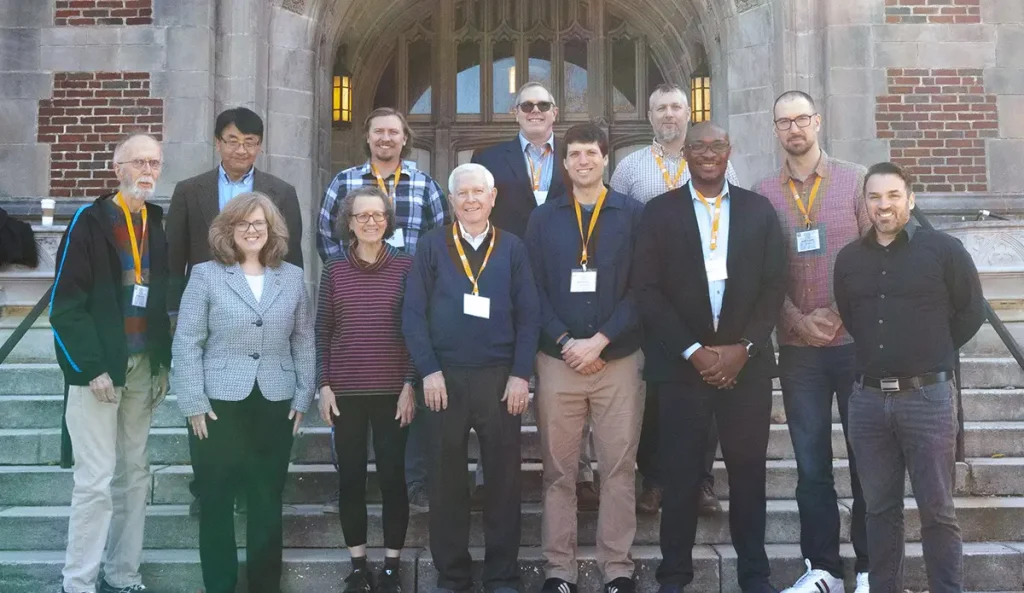
    • Board of Visitors
  • Events and Visitors
    • Calendar
    • SIAM SEAS 2025
    • Barrett Memorial Lectures
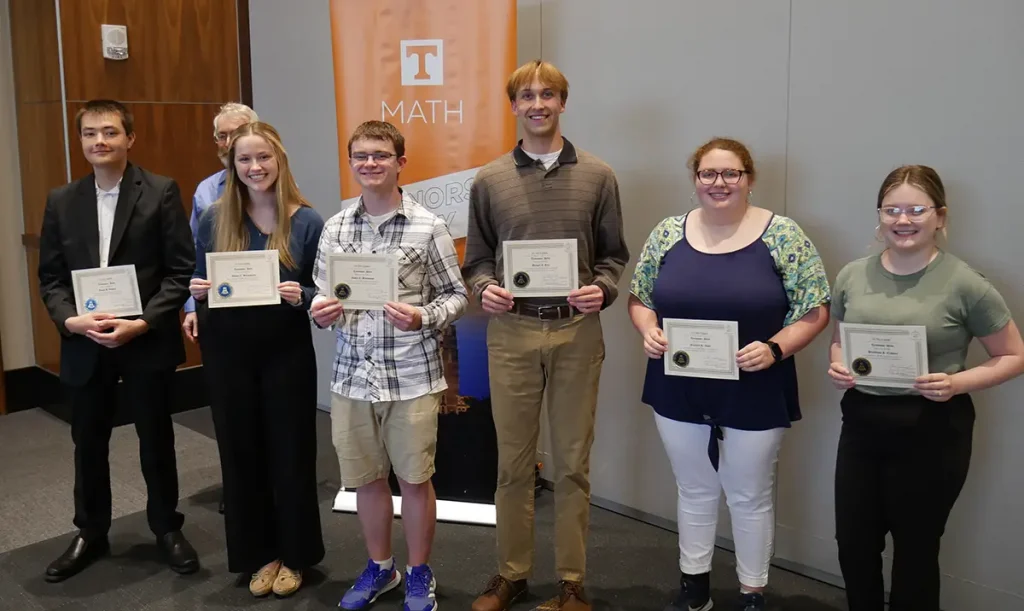
    • Honors Day 2025
Home » Page 2

Archives

Alumnus Ryan Unger an NSF Researcher

October 21, 2024 by Logan Judy

Headshot photo

Ryan Unger came to UT as an engineering student and started doing undergraduate research on experimental materials science in nuclear engineering. In his freshman year, he treated mathematics as a hobby and did not think it was a viable career option.

The more mathematics courses he took, however, the more he liked mathematics. Taking several upper-level and graduate-level courses with professors including Alex Freire, Theodora Bourni, Mat Langford—in advanced calculus, differential equations, and the calculus of variations and geometric analysis—convinced Unger of his love and passion for mathematics. 

He earned a bachelor’s degree with honors from UT in 2019 and then excelled as a graduate student at Princeton University. He earned his doctorate in May 2024 and was a winner of the Porter Ogden Jacobus Fellowship, the top graduate student honor from Princeton. 

Upon graduation, he received a string of prestigious fellowship offers from many top schools. Unger is now a National Science Foundation postdoctoral researcher at Stanford University and simultaneously a Miller Fellow at the University of California at Berkeley. Well done and congratulations, Ryan!


Filed Under: Newsletter

Alumnus Owen Queen Recognized for Leadership

October 21, 2024 by Logan Judy

Owen Queen graduated from UT in May 2020 with a double major in computer science and mathematics. His undergraduate research spanned artificial intelligence and data science in genomics, materials science, and epidemiology. 

As a junior, Queen earned the prestigious Barry Goldwater Scholarship which is regarded as the most prestigious undergraduate STEM (science, technology, engineering, and math) scholarship in the United States. He did his honors research on computational materials science under the direction of Professors Vasileios Maroulas (math) and Konstantinos Vogiatzis (chemistry), which resulted in publishing his first authored research paper in the highly selective npj Computational Materials in 2023. 

Beyond his academic pursuits, Queen was deeply committed to aiding underserved communities across the United States through his volunteer work with Remote Area Medical, a nonprofit organization dedicated to providing high-quality healthcare to those in need.  

Queen earned a doctorate in computer science at Stanford University. In May he was named one of the 2024 Knight-Hennessy Scholars, which is among the most prestigious postgraduate fellowships in the world. Recipients are selected based on demonstrating independence of thought, purposeful leadership, and a civic mindset. Great job and congratulations, Owen!


Filed Under: Newsletter

Clark Focuses on Math Education

October 21, 2024 by Logan Judy

A man and a woman standing in traditional Ghana dress in a classroom on campus

With a master’s degree in mathematics and a PhD in mathematics education, JENEVA CLARK has unique perspectives on teaching mathematics. Her research and connections are forging new opportunities for faculty and students at UT. 

Clark joined the Department of Mathematics faculty in 2006 and has taught and coordinated Mathematical Reasoning courses for many years. She regularly teaches Geometry and History of Mathematics and has mentored many math graduate students in teaching. Clark has been involved in 14 funded grants, serving as principal investigator on nine.

Her interest in teaching mathematics extends back to her experience in elementary school. She loves designing fun and engaging lessons, teaching undergraduate mathematics, advising future teachers, mentoring future faculty, and implementing professional development for K-12 teachers. 

Her doctoral dissertation focused on how students learn from errors. “University students in my quasi-experimental study judged that correct work samples, sanitized from errors, were more helpful to them, but the data proved that analyzing work with errors was more helpful to their learning,” Clark explained.

Recent research she directed examined the differences in how US faculty and graduate students from America and Ghana judge the elegance of given proofs. “The findings were that elegance in proofs is not well-defined and varies greatly based on status and geography,” Clark said. 

She’s hoping to delve into further cross-cultural educational studies with co-researchers in Ghana and other countries.

During the past academic year, she championed to establishment of a new collaborative relationship between UT and a university in Ghana, where she has been conducting outreach and research for the past several years. A new memorandum of understanding between UT and Akenten Appiah-Menka University of Skills Training and Entrepreneurial Development (AAMUSTED) will bring opportunities for the mathematics and other departments to collaborate. Possibilities include joint programs, jointly funded projects, student exchange programs, and visiting faculty arrangements, for example.

“Sharing students, sharing research, sharing expertise, and sharing programs are all great ways to strengthen both institutions,” she said. 

During the past academic year, she also organized two events on the Knoxville campus: the Program Assessment Conference for Mathematics [P.A.C.-Math]: Tools for Math Departments to Self-Assess GTA Professional Development Programs in October 2023 and the 103rd Mathematical Association of America Southeastern (MAA-SE) Section Meeting in March 2024. 

Clark, who received the 2023 MAA-SE Section Distinguished Teaching Award, took the opportunity in delivering the plenary talk to honor William Brodie. He was one of four members turned away from the MAA section meeting conference hotel in 1960 because of their race, and during the 2024 conference at UT received a formal apology form the southeastern chair of the MAA. Clark is collaborating with the UT Department of Africana Studies on a new book chapter about Brodie.

Filed Under: Newsletter

Lenhart Delivers Gibbs Lecture

October 21, 2024 by Logan Judy

Suzanne Lenhart with students

Suzanne Lenhart’s achievements in applied mathematics were highlighted this year with her invitation from the American Mathematical Society (AMS) to deliver the Josiah Willard Gibbs Lecture. 

Her speech to an international audience on January 4 at the Joint Mathematics Meetings in San Francisco—the largest math conference in the world—focused on the impact of math in natural systems management. 

Lenhart’s research involves differential equations and optimal control of biological and physical models, especially population and epidemiological models. Currently she is working on infectious disease models and applications in natural resources.

During the Gibbs Lecture, she showed the power of mathematical models to inform management in ecological systems, from wildfire controls to choosing therapy for patients with Alzheimer’s disease. In the area of climate change, for example, predictive models showing the impact of rising temperatures on the hatchlings of loggerhead sea turtles can guide conservation plans.

Headshot photo of Suzanne Lenhart

Lenhart joined the faculty of the University of Tennessee, Knoxville, in 1981 and has been named a Chancellor’s Professor and the James R. Cox Professor of Mathematics. She also was a part-time research staff member at Oak Ridge National Laboratory from 1987-2009. 

Her leadership in the Department of Mathematics includes 15 years as director of the Research Experiences for Undergraduates (REU). She also served as associate director for education, outreach, and diversity of the National Institute for Mathematical and Biological Synthesis (NIMBioS) from 2009-2021 and organized the summer Research for Undergraduates program.

Lenhart is a fellow of AMS, the Society for Industrial and Applied Mathematics, the American Association for the Advancement of Science, and the Association for Women in Mathematics. She served as AWM president in 2001-2002. 

She has organized outreach efforts to several middle and high schools and teacher workshops and served as co-principal investigator on a research collaboration with students and faculty in southern Africa, funded through the National Science Foundation.

Lenhart has been the research advisor for 37 master’s students, 33 PhD students, and 15 postdoctoral candidates. “I love teaching and collaborating on research,” she said. “I enjoy advising PhD and master’s students.”

AT UT, she has mentored women, students with disabilities, those who are racial or ethnic minorities, and students from disadvantaged socioeconomic backgrounds.

“My mentoring activity has been rooted in my personal experience as a woman, coming from a low-income household led by my mother,” Lenhart said. “As my career developed, I learned more about access and inclusivity, which led to deeper involvement with programs about increasing opportunities and improving equity.”

“Our department has strong diversity in the faculty now, and there are many more graduate students,” she said. “A variety of backgrounds and viewpoints enables us to serve a wide spectrum of graduate students.”

Over the past century, the notable mathematicians who have delivered the Gibbs lecture include Albert Einstein, Robert May of Oxford University, Cathleen Morawetz of New York’s Courant Institute of Mathematical Sciences, and Ingrid Daubechies from Princeton University.

Filed Under: Newsletter

New Faculty and Postdoctoral Associates, 2023-2024

October 21, 2024 by Logan Judy

The Department of Mathematics welcomed three tenure-line faculty, eight professional teaching faculty, and four postdoctoral associates. Learn more about the faculty on the department’s website.

Tenure-Track Faculty

Headshot photo

Hung Nguyen

Assistant Professor, Probability

My interest in research lies mainly in the field of probability and stochastic differential equations (SDEs). I am currently working on Lyapunov constructions for SDEs to obtain ergodicity and mixing.


Headshot photo

Yulan Qing

Assistant Professor, Topology

My research interests lie in the field of low-dimensional topology and geometric group theory. My current research projects include the generalization of the Gromov boundary, studies of various notions of genericity in groups, geometricity in Out(Fn), and generalizations of curve graphs in different settings.


Headshot photo

Xinyue Zhao

Assistant Professor, Math Biology

My research interests lie in the field of partial differential equations and applied mathematics. In particular, I am interested in using mathematical tools, both theoretical and numerical, to analyze biological and physical models and discover exciting implications from these models.


Postdoctoral Associates

Headshot photo

Letian Chen

Geometric Analysis

I earned a doctorate from Johns Hopkins University in 2023 under the direction of Professor Jacob Bernstein. I am interested in geometric analysis and geometric measure theory, in particular, mean curvature flows, minimal surfaces, and other geometric evolution equations.


Headshot photo

Efstathios K. Chrontsios Garitsis

Analysis

My research interests are mostly focused on fractals and include fractal geometry, quasiconformal mappings, analysis and geometry on metric spaces, and complex dynamics. I also am interested in connections of fractal geometry with optimization and number theory.


Wyatt Mackey

Data Science

I earned my PhD from Stanford University under the direction of Professors Gunnar Carlsson and Ravi Zakil. My research areas include applied algebraic topology and cohomology. 


Non-Tenure-Line Faculty

Headshot Photo
Khursed Ansari
Headshot Photo
Mark Bly
Headshot Photo
Kathryn Dabbs
Headshot Photo
Betsy Downs
Headshot Photo
Hung Duong
Headshot Photo
Hung Le
Headshot Photo
Jeremy Siegert

Not Pictured: Leona Sparaco

Filed Under: Newsletter

Graduate Student Excels in Research, Teaching

October 18, 2024 by Logan Judy

Joshua Siktar pursued his interests in both mathematical analysis and computational mathematics while earning his PhD at UT, completing the degree this year. 

Siktar entered the program in the fall of 2019 and worked with two advisors, Professors Tadele Mengesha and Abner Salgado. 

He wrote his doctoral thesis on some aspects of the mathematical and numerical analysis of a contemporary nonlocal model of the deformation of elastic solids. 

The model involves integral equations, instead of the commonly used differential equations, and it is found to be effective in modeling the emergence of singularities, such as fractures and cracks, in materials when material bodies are subjected to an external force.

His main research focus was on the optimal control and optimal design of such models that appear in solid mechanics. In his first project, he analyzed the mathematical framework that leads to obtaining an optimal external force, used as a control, that produces an optimal displacement field that is the closest to a desired field with the minimum possible cost of applying the force. He has demonstrated rigorously that such an optimal pair of force and displacement fields exist and are unique. In the event of vanishing nonlocality, he has proved that the limiting fields are also optimal fields for the well-studied classical linearized elasticity model.

Siktar also studied the finite element-based discretization of the problem, where he proved convergence as well as the asymptotic compatibility of the scheme in the event of vanishing nonlocality. The project led to a publication in a peer-reviewed journal.

His second project was on an optimal design problem related to these nonlocal problems. This project is related to the modeling of composite materials where an arrangement of constituent materials is sought that will lead to the designing of a material with particular effective behavior. In analyzing these models, he used a variety of mathematical tools from the calculus of variations, functional and numerical analysis, and differential equations techniques, to name a few. 

Siktar’s curiosity and eagerness to learn, the mark of a true researcher and scholar, motivated him to work also with Professor Xiaobing Feng on some problems related to what is known as the Lavrentiev phenomenon in the calculus of variations. 

Essentially, this phenomenon appears when trying to minimize functions (energies) of a somewhat nonstandard structure. Minimizing over a slightly smaller set leads to a bigger value than the true minimum. Most physical processes are based on some energy minimization principle. For this reason, being able to identify when this phenomenon occurs and how to mitigate it bears great importance in applications.

In addition to his research, Siktar showed great interest in teaching and mentoring. While at UT he was nominated for several teaching awards, including the Math GTA Teaching Award. He guided undergraduate students in research projects that led to publications in mathematical journals dedicated to undergraduate research.

Siktar, who earned his bachelor’s degree in mathematics from Carnegie Mellon University in 2018, has accepted a postdoctoral position at Texas A&M University.

Filed Under: Newsletter

Message from Department Head Xiaobing Feng

October 18, 2024 by Logan Judy

Headshot photo of Xiaobing Feng

Dear friends of the UT Department of Mathematics,

As the 2023-2024 academic year has wound down, let us reflect on a remarkable year and look ahead to the future.

Riding on the momentum of 2022-2023, our department continued to rise along with the university’s rise. We had another phenomenal year of growth. We hired one full professor, one associate professor, and one assistant professor. Twelve new full-time lecturers joined our department, adding needed teaching power for service math courses. Two full-time staff members also joined our department to manage the Testing Support Center and the Math Place, providing critically important service for our instructors and all University of Tennessee, Knoxville, students. The department welcomed a record 34 graduate students, and the total number of graduate teaching assistants (GTAs) has exceeded 100. Finally, incoming math majors increased from 30 to 40, and math honors jumped from 17 to 28. With a new actuarial science program, it is expected that math majors will significantly increase in the next few years. 

As the university grows, so does the Department of Mathematics. While building on the department’s strengths in both pure and applied mathematical research and graduate education, we have been investing in future growth in cutting-edge and impactful areas such as artificial intelligence, data science, and machine learning, by hiring more faculty in those areas. Moreover, we have been collaborating with other departments within the College of Arts and Sciences (such as physics, chemistry, and biology) and units outside the college or university (e.g., industrial engineering, mechanical engineering, health sciences, electrical engineering and computer science, the UT Institute of Agriculture, the UT-Oak Ridge Innovation Institute’s Bredesen Center, and Oak Ridge National Lab) for interdisciplinary research and projects. 

Mathematics, which is the language of sciences, engineering/technology, and economics/finance, is ubiquitous and plays an increasing role in modern sciences, engineering, industry, and society. We believe that a strong Department of Mathematics is a necessity for the university and are dedicated to actively contributing to the realization of UT’s strategic vision. Through outstanding research, interdisciplinary collaboration, and unwavering commitment to transformational education, our goal is to continue to shape the future of mathematics and inspire new generations of scholars.

The past year also was marked by a comprehensive Academic Program Review (APR), which occurs once every 10 years. Although the onsite review by an external committee took only three days, its preparation spanned over six months by our departmental APR committee. 

The goal of a comprehensive APR is for the university to evaluate the department’s effectiveness in teaching, research/creative activity, and service. It also provides the department opportunities for self-study and analysis about what it has done and to plan for the future. Moreover, it provides a valuable opportunity for the department administration to discuss with the college and university administrations the department’s concerns, needs, and vision, and seek their help to achieve the department’s goals and mission. 

An external APR committee came to UT from March 31–April 2, 2024, submitted an evaluation report, and made constructive recommendations. Here are a few excerpts:

  • “The department has clearly demonstrated a willingness and an ability to serve the mission of the university. No other department on campus has served the university to this degree ….”
  • “Despite its stretched resources, the tenure-line faculty, lecturers, and GTAs do an excellent job handling increased enrollments and serving the many undergraduates that take mathematics courses at UT. The commitment to teaching and to the department as a whole, and the overall morale of the lecturers, is striking.”
  • “The (math department) tenure-line faculty research contributions are world-class and have an impact in a variety of areas of mathematics and its application.” “The mathematical biology program, which started on campus 30 years ago and ultimately resulted in securing a major NSF center in NIMBioS, was one of campus’s crown jewels.”

The APR committee’s report was overall positive, objective, and constructive. Our department will collaborate with the college and university administrations to implement recommendations from the report in the next few years. For example, the department will create a course scheduling manager post to improve the efficiency in making teaching assignments and develop policies for incentivizing faculty to obtain external research grants and advise graduate students to write theses and dissertations. 

In the pages that follow, you will find selected profiles of our faculty, graduate students, and undergraduate math majors, as well as information about our Board of Visitors. I hope you enjoy reading about the many wonderful things that happened in our department over the past year.

With gratitude and best wishes,

Xiaobing Feng
Professor and head

Filed Under: Newsletter

Growing Enrollment, Programs, Expertise, and Reach

October 18, 2024 by Logan Judy

Suzanne Lenhart teaching two students

The Department of Mathematics has seen remarkable growth alongside the University of Tennessee, Knoxville, teaching a record number of students in the 2023-2024 academic year and building on phenomenal growth the year before. 

With 37 tenure-line faculty, 38 full-time lecturers, more than 100 graduate students, and 10 full-time staff members, the department is the largest on the Knoxville campus by far. 

Enrollment in lower-division math courses hit 18,600 in the past academic year, an increase of 3,700 from 2021-22. Ten graduate students received PhDs and 22 earned master’s degrees. Meanwhile, the department welcomed 34 new graduate students, a record number.

The department added three new tenure-line faculty members whose research areas include probability, topology, and math biology. It also welcomed eight full-time lecturers, all with doctorates, with five in new positions.

Starting in the fall of 2024, students have a new option to complete a math major with an actuarial science concentration. Professor Qiang Wu, an associate of the Society of Actuaries, joined the department to lead the program. 

“Student interest is already growing, and over the last year, several students successfully passed actuarial exams or completed internships,” said Professor Joan Lind, associate head of the department for math majors and minors. 

This fall the department also launched a new undergraduate research forum, the Knox Math Lab. 

“This forum will allow us to better facilitate undergraduate research by supporting faculty, utilizing graduate students as mentors, and providing more opportunities and clearer pathways for undergraduate students to engage in math research,” Lind said.

The Math Honors Program, a nationally competitive program for highly motivated and mathematically gifted undergraduate students, also has seen a significant increase. Nearly 30 students were in the program during the 2023-2024 academic year, with about 10 expected to graduate in 2024-25.

The graduate program continued to expand, with a total of 102 graduate teaching assistants in the fall of 2023. Grants, fellowships, and self-supported students brought the total to 117 graduate students in the on-campus program.

“We are proud of the diversity of students we have from around the world,” said Professor Tim Schulze, director of graduate studies and associate head for research and development. “We have recently welcomed students from China, the Dominican Republic, India, Sri Lanka, and Vietnam.”

Recent graduate students have accepted jobs in academia, industry, and government offices, including the Department of Defense, Major League Baseball, and Oak Ridge National Laboratory. 

With the movement of the Master of Mathematics to a fully online program in recent years, it is drawing enrollment from teachers across the country seeking to expand their mathematical training.

Enrollment in Lower Division Courses

  • 18,600

Graduate Degrees Awarded

  • 10 Doctors of Mathematics
  • 17 Masters of Science
  • 5  Masters of Mathematics

Faculty and Staff

  • 37 tenure-line faculty
  • 38 full-time lecturers
  • 102 graduate teaching assistants
  • 10 full-time staff members

Filed Under: Newsletter

Awards and Honors

May 15, 2024 by Logan Judy

Professor Marie Jameson
Professor Steven Wise
  1. Professor Steven Wise received the 2022 College Arts and Sciences Senior Research Award. 
  2. Professor Marie Jameson received the 2022 College Arts and Sciences James R. and Nell W. Cunningham Outstanding Teaching Award.
  3. Professor Nina Fefferman received the 2022 College Arts and Sciences Faculty Academic Outreach Service Award. 
  4. Dr. Jeneva Clark received 2023 MAA Southeastern Section Distinguished Teaching Award.
  5. Professor Louis Gross received the 2022 College Arts and Sciences Marshal Award.
  6. Professor Louis Gross was the 2022 UT Macebearer. 
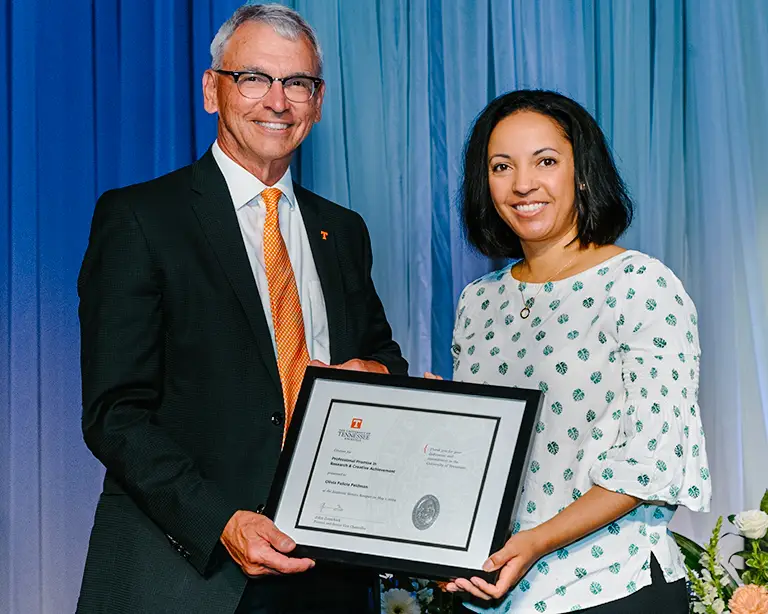
  7. Professor Suzanne Lenhart received the 2022 UT Research and Creative Achievement Award. 
  8. Dr. Anne Hou received the 2022 College Arts and Sciences Lecturer Excellence Teaching Award.
  9. Professor Olivia Prosper Received an NSF CAREER Award in 2021. 
  10. Professor Morwen Thistlethwaite was elected as an AMS Fellow in 2021.

Filed Under: Newsletter

The Math Place

May 15, 2024 by Logan Judy

Students studying in a common area with a sign that says "The Math Place"

The Math Place, located in Hodges Library North Commons, provides students with a great atmosphere where they can work on all aspects of their math classes.  The staff of undergraduate peer learning assistants bring a positive attitude and strong knowledge base that fosters student learning and confidence.  While being surrounded by peers who are taking the same course as they are builds a sense of community and comradery.  All of this helps The Math Place have a big impact on student success.


Filed Under: Newsletter

  • « Previous Page
  • 1
  • 2
  • 3
  • 4
  • 5
  • Next Page »

Department of Math

College of Arts and Sciences

227 Ayres Hall
1403 Circle Drive
Knoxville TN 37996-1320

Email: math_info@utk.edu

Phone: 865-974-2461

The University of Tennessee, Knoxville
Knoxville, Tennessee 37996
865-974-1000

The flagship campus of the University of Tennessee System and partner in the Tennessee Transfer Pathway.

ADA Privacy Safety Title IX